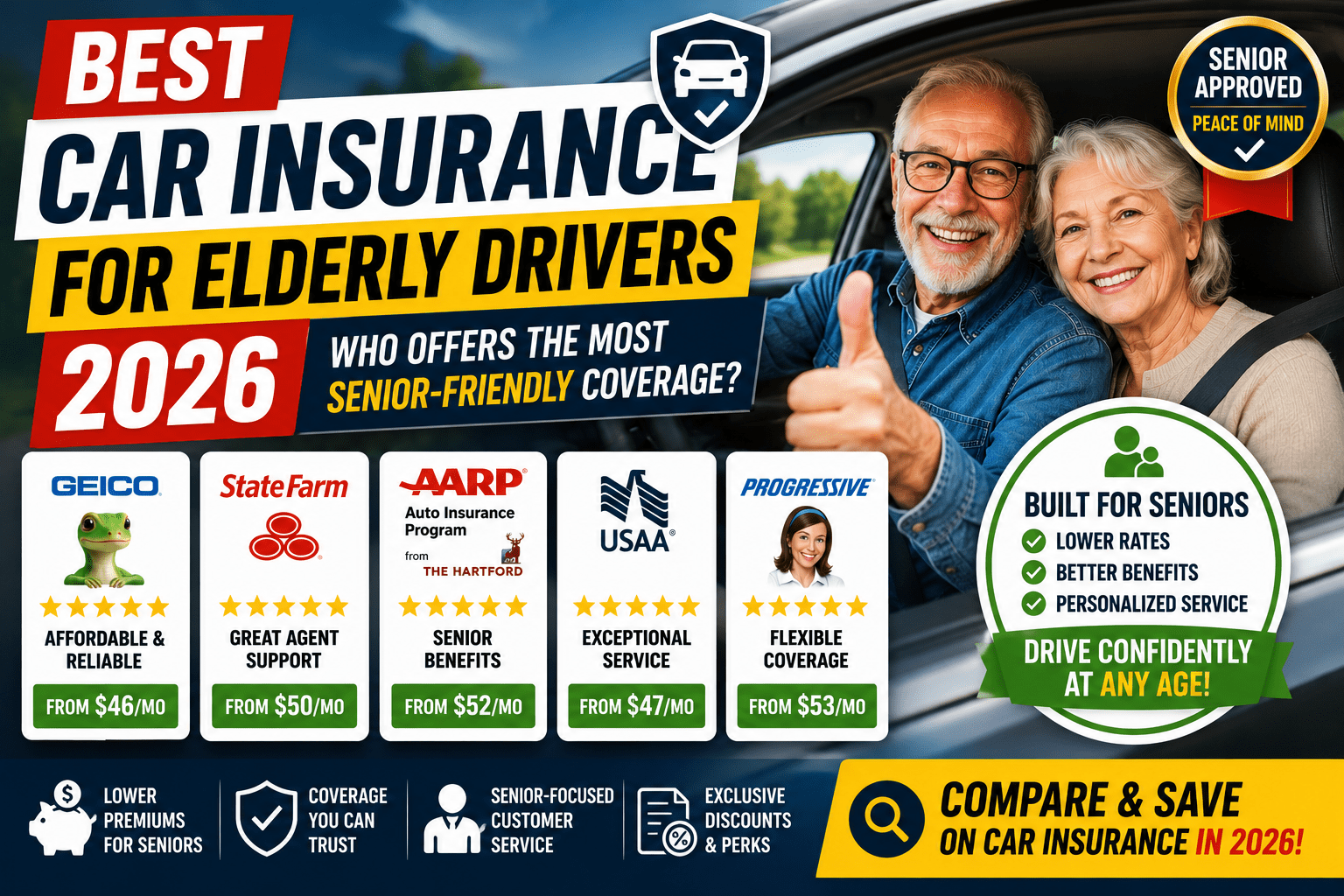
Best Car Insurance for Elderly Drivers 2026: Who Offers the Most Senior-Friendly Coverage?
📋 Short Summary
For drivers 65 and older, car insurance isn’t just about price — it’s about finding a company that will stay with you, treat you fairly after a claim, and offer coverage features that actually fit your life stage. In this guide, I break down the best car insurance options for elderly drivers in 2026, what features matter most at this age, which companies offer lifetime renewability, what MedPay coverage is and why it matters more as you age, and which companies are genuinely worth your business — not just the ones with the best ads. Real data, real comparisons, and my honest recommendation for different situations.
Why Is Choosing Car Insurance Different for Elderly Drivers Than for Younger Seniors?
There’s a meaningful difference between a 52-year-old shopping for car insurance and a 74-year-old doing the same thing. The goals, the risks, the priority features — they diverge in important ways that most general insurance guides completely ignore.
For drivers in their 50s and early 60s, the priority is primarily cost optimization. You’re in a favorable risk tier, and the main job is to make sure your insurer is pricing that in correctly. After 65 or 70, something changes. Rates start nudging upward again. Some insurers start non-renewing drivers based on age-related underwriting concerns. And the consequences of being inadequately covered after an accident — medical costs, asset exposure, the difficulty of navigating a claims process — are more serious.
For elderly drivers, the best car insurance isn’t necessarily the cheapest. It’s the one that won’t abandon you, will pay claims fairly, and provides the coverage features that are genuinely relevant to your life. That’s what this guide is about.
For the full senior driver strategy guide, see: How to Cut Your Car Insurance Bill in Half After Turning 50 (2026 Method).
What Are the Unique Insurance Challenges Drivers Over 70 Face?
After 70, several factors converge that make insurance planning more complex. Actuarially, accident rates begin rising for drivers over 70 — not dramatically, but measurably — and insurers price accordingly. Reaction times slow, vision and night driving become more challenging, and medication interactions can affect driving performance. Insurers are aware of all of this.
In practice, this means: some insurers will increase your renewal rate more aggressively; a small number may decline to renew your policy; and the likelihood of a serious injury claim — which is expensive — increases. This doesn’t mean elderly drivers are bad drivers. Many drivers in their 70s are excellent. It means the statistical risk profile shifts enough that insurers treat this group differently.
The right response is to be strategic: choose an insurer that won’t penalize you unfairly, carry coverage levels that genuinely protect you, and stay on top of your renewal pricing so you’re never surprised.
Which Car Insurance Companies Are Most Senior-Friendly in 2026?
| Company | Avg. Annual (70+) | Age Non-Renewal Risk | Standout Elderly Feature | Elderly Driver Score |
|---|---|---|---|---|
| The Hartford / AARP | $1,380 | Very Low (Lifetime Guarantee) | Cannot cancel for age alone. RecoverCare. | ⭐ 9.5/10 |
| USAA | $1,120 | Very Low | Best pricing, excellent service (military only) | ⭐ 9.8/10 (if eligible) |
| State Farm | $1,410 | Low–Moderate | Local agents, consistent renewal history | 8.4/10 |
| GEICO | $1,290 | Moderate | Mature driver discount, competitive pricing | 8.0/10 |
| Nationwide | $1,450 | Low–Moderate | Vanishing deductible, SmartRide UBI | 7.8/10 |
| Progressive | $1,520 | Moderate–Higher | Lenient with accident history | 7.2/10 |
Why Is Lifetime Renewability Such a Critical Feature for Elderly Drivers?
This is the feature I would never give up if I were 70 or older. Here’s a scenario that plays out every year across the country: a 76-year-old driver with a clean record opens their renewal notice to find their insurer is declining to renew. No accident. No violations. Just age. Suddenly they’re in the non-standard market, where rates are 30–60% higher and coverage options are limited.
The Hartford’s AARP program offers a genuine lifetime renewability guarantee: as long as you maintain your AARP membership, meet basic license requirements, and don’t have a record of catastrophic violations, they cannot decline to renew your policy solely because of your age. For an elderly driver who values stability and predictability, this single feature is often worth more than any premium difference.
It’s the policy equivalent of knowing the rug won’t get pulled out from under you. For drivers 65+ who plan to keep driving into their 70s and beyond, this should weigh heavily in your insurer selection.
What Coverage Features Matter Most for Elderly Drivers?
As you age, some coverages that seemed optional in your 40s become genuinely important:
| Coverage Type | Priority Level for 65+ | Why It Matters |
|---|---|---|
| High Liability ($100k/$300k+) | Essential | Protects retirement savings and home equity if you cause an accident |
| MedPay / PIP | Essential | Medicare has gaps; MedPay covers injury costs immediately after accident |
| Uninsured Motorist | Essential | One in eight drivers is uninsured; injuries more serious and costly at older ages |
| RecoverCare / Daily Living | Highly Recommended | Covers home help during recovery — unique to Hartford/AARP |
| Roadside Assistance | Recommended | More valuable as age increases; worth having unless AAA member |
| Collision (older vehicles) | Optional / Consider Dropping | If vehicle value under $7,000, consider dropping to save $300–$500/year |
What Is RecoverCare and Why Should Elderly Drivers Care About It?
RecoverCare is a coverage feature exclusive to The Hartford’s AARP program, and it’s one of the most thoughtful insurance innovations I’ve seen in years. Here’s how it works: if you’re injured in a covered accident, RecoverCare pays for necessary services you can’t perform yourself during recovery — things like grocery delivery, transportation to medical appointments, house cleaning, and lawn care.
The coverage limit is typically $2,500 per accident, which isn’t enormous — but for an older driver recovering alone from an injury, it can be the difference between managing at home and needing residential care. It covers the real-world gap that health insurance doesn’t.
Think about it this way: a 72-year-old who lives alone and breaks her wrist in a minor accident suddenly can’t drive, can’t cook easily, can’t do laundry. RecoverCare pays for someone to help with all of that while she recovers. That’s coverage that maps to actual life — not just actuarial abstractions.
No other major insurer offers an equivalent benefit. For elderly drivers, particularly those living alone or without immediate family nearby, this feature alone can make The Hartford the right choice even if it’s not the cheapest quote.
What Is the Cheapest Car Insurance for Elderly Drivers Who Have a Limited Budget?
For elderly drivers on fixed incomes, price genuinely matters — and I don’t want to dismiss that by only recommending premium coverage. Here’s the honest path to the cheapest responsible coverage for elderly drivers:
Step-by-Step: Getting the Cheapest Responsible Coverage as an Elderly Driver
- Assess your vehicle’s value. If it’s under $7,000, dropping collision (and possibly raising the comprehensive deductible to $1,000) is the single fastest way to reduce your bill by $300–$600/year without exposing yourself to meaningful financial risk.
- Check your mileage honestly. If you’re driving under 6,000 miles per year, apply for every low-mileage discount available and seriously consider a pay-per-mile program.
- Get a Hartford quote if you’re AARP-eligible. The $16 AARP membership cost is almost always recovered within the first month of the discounted premium.
- Run at least 4 more comparison quotes. Use The Zebra or Insurify. The market moves fast; what was expensive last year may be cheapest today.
- Don’t skip MedPay or PIP. It’s typically $20–$50/year added to your premium and can save you thousands in out-of-pocket medical costs after even a minor accident. Never drop this to save money.
- Ask specifically about senior, loyalty, and defensive driving discounts with every insurer you contact. Not all are automatically applied.
💡 If I Were in My 70s and On a Fixed Income…
I’d prioritize The Hartford/AARP for the lifetime renewability guarantee — even if it cost slightly more than the cheapest quote. The peace of mind of knowing I can’t be non-renewed solely due to age is worth $10–$20/month in premium difference. I’d then aggressively stack every discount available to bring that price down: defensive driving course, pay-in-full, low-mileage, paperless. That combination usually gets The Hartford’s price to within $100–$150 of the cheapest competitors — and the coverage features are worth more than that difference.
Frequently Asked Questions: Best Car Insurance for Elderly Drivers
🔗 Related Guides for Senior and Elderly Drivers
- → How to Cut Your Car Insurance Bill in Half After Turning 50 (2026 Method) — Main Strategy Guide
- → Best Car Insurance for Older Drivers 2026: Top Companies Compared
- → Cheapest Car Insurance for Seniors Over 50 in 2026
- → Cheap Car Insurance Over 60: How to Pay Less After Age 60 in 2026
- → Cheap Auto Insurance for 55 and Older – Best Discounts & Strategies
- → Car Insurance Quotes for Older Drivers: How to Get the Lowest Rates in 2026