SR22 Cheap Car Insurance for Seniors in Florida – Low Cost Options After DUI
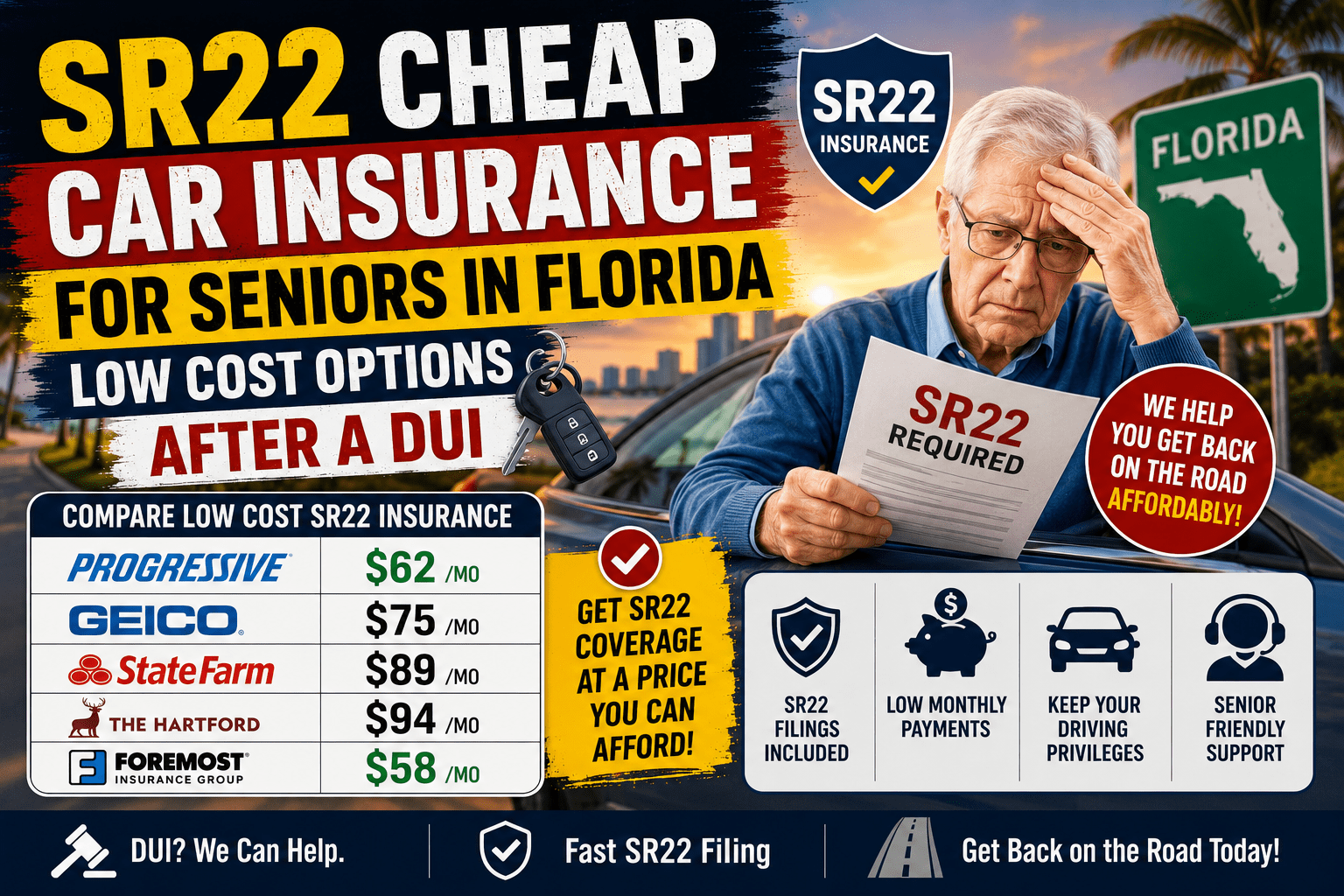
A DUI doesn’t mean you’re uninsurable — but it does mean the rules change. Here’s exactly what SR22 means, what it costs Florida seniors, and the real path to affordable coverage again.
📋 Short Summary
Florida seniors who receive a DUI will need an SR22 certificate filed with the state — and their insurance rates will rise significantly, typically $80–$150/month above standard rates. The good news: SR22 is not permanent. In Florida, the filing period is usually 3 years. During that time, several non-standard and specialty insurers offer relatively competitive rates. This guide walks through what SR22 actually is, what it costs for seniors, which Florida companies offer the cheapest SR22 policies, and the exact steps to get your rate as low as possible during the filing period.
What Happens to a Senior’s Car Insurance After a DUI in Florida?
I want to start this guide without judgment, because the reality is that DUI situations among seniors are more common than many people acknowledge — and they’re often very different from the stereotype. Medication interactions. One glass of wine at a dinner party. A medical event that mimics impairment. Whatever the circumstances, the legal and insurance consequences are real, and you need practical information.
Here’s the sequence of what typically happens after a DUI conviction in Florida:
License suspension
First DUI: minimum 180 days. Second DUI: up to 5 years. Third within 10 years: up to 10 years. You may be eligible for a hardship license that allows driving to work, medical appointments, and other essential needs.
SR22 filing requirement
Florida requires you to file an SR22 certificate (a form your insurer submits to the FLHSMV) proving you carry at least the state minimum insurance. This is required before your license can be reinstated. Most first DUI offenses require 3 years of continuous SR22 filing.
Rate increase and possible policy cancellation
Your current insurer may cancel your policy or increase your rate dramatically. Most standard-market carriers (Hartford, GEICO, State Farm) will decline to file an SR22 or will cancel coverage after a DUI. You’ll likely need to find a non-standard or specialty insurer.
DUI school and ignition interlock (in some cases)
Florida requires DUI school completion before license reinstatement. A second conviction or BAC of 0.15+ typically requires an ignition interlock device. Some insurers factor compliance into their rates — completing these requirements promptly helps.
The critical point: none of this is permanent. The SR22 period ends, rates gradually return to normal, and you rebuild your record. The goal right now is to get through the 3-year filing period at the lowest possible cost while maintaining appropriate coverage.
This is part of our broader Florida senior car insurance series. For context on standard rates and options, see our main guide on why Florida seniors are overpaying for car insurance.
What Exactly Is an SR22 — and What Does It Actually Do?
One of the most common misconceptions I encounter: people think SR22 is a special type of insurance. It’s not. SR22 is a certificate — a form filed by your insurance company with the Florida Department of Highway Safety and Motor Vehicles (FLHSMV) confirming that you maintain at least the state’s minimum required coverage.
⚠️ Critical Warning: Never Let Your SR22 Lapse
If your insurance policy lapses — even for a single day — your insurer is required to notify the FLHSMV, which will immediately suspend your license again. You’ll then need to restart the entire 3-year filing period from scratch. This is the single most costly mistake people make in the SR22 process. Set up automatic payment and never cancel without an active replacement policy already in place.
How Much Does SR22 Car Insurance Cost for Senior Drivers in Florida?
The short version: expect your rates to roughly double, at minimum, for the first year after a DUI. Here’s a realistic breakdown of what Florida seniors can expect:
*Estimated rates using non-standard/specialty carrier pricing. Standard market carriers (Hartford, GEICO, State Farm) typically decline to write SR22 policies or charge significantly higher rates. Your exact rate will depend on BAC level, whether there was an accident, prior record, and ZIP code.
The non-owner SR22 option in that last row deserves special attention. If you don’t own a car but need to fulfill the SR22 filing requirement, a non-owner policy can be dramatically cheaper — sometimes under $100/month. This is an especially relevant option for seniors who are living with family, rarely need to drive, or whose car has been sold or impounded.
Which Insurance Companies Offer the Cheapest SR22 Policies for Seniors in Florida?
The standard carriers most seniors know — Hartford, GEICO, State Farm — will often drop you or decline to write a new SR22 policy. Here’s a realistic breakdown of the Florida market for post-DUI senior drivers:
💬 My Experience: Dairyland and Progressive are consistently the two best starting points for Florida seniors needing SR22. Progressive gives you a somewhat standard-market experience with online management. Dairyland is purpose-built for non-standard situations and often comes in cheaper. Get quotes from both — and from The General as a third option — before deciding. The differences can be $40–$70/month for the same coverage.
What Are the Exact Steps to Get the Cheapest SR22 Insurance as a Florida Senior?
This is the process I’d walk anyone through — methodically, so nothing falls through the cracks:
Confirm the exact SR22 requirement from the court or FLHSMV
Before shopping for insurance, get the official documentation specifying your SR22 requirement, duration, and the minimum coverage limits required. Courts sometimes have different requirements than the state minimum. Don’t rely on what someone told you verbally — get it in writing from the FLHSMV or your attorney.
Decide: Do you need an owner or non-owner policy?
If you own a vehicle → you need a standard SR22 policy attached to that vehicle. If you don’t own a car but need to drive occasionally → a non-owner SR22 policy is significantly cheaper, often $60–$100/month, and still fulfills the filing requirement. This decision alone can save hundreds of dollars per year.
Get quotes from at least three SR22-capable insurers
Start with Dairyland, Progressive, and The General. Use SR22-specific comparison sites like The Zebra, SR22Compare.com, or Insurify. These platforms are set up specifically to surface non-standard market options that general comparison tools often miss.
Don’t sacrifice liability coverage to save money
The temptation with SR22 is to drop everything to the state minimum to minimize cost. I strongly advise against this. Florida’s $10,000 property damage minimum is dangerously low — a single moderate accident can exceed that. Senior drivers’ retirement savings are directly at risk if you’re underinsured and cause a serious accident. Carry at least $50k property damage and $100k/$300k bodily injury.
Set up automatic payment — immediately
I can’t stress this enough. Any lapse resets your 3-year period. Set up autopay from a bank account the day your policy starts. Put a calendar reminder 30 days before renewal. Never, ever let this policy lapse. If you have trouble keeping track of bills, ask a trusted family member to help monitor it.
Complete all required DUI school and interlock requirements promptly
Completing the DUI Level I or Level II course and any interlock requirements immediately — not dragging them out — signals to the insurance system that you’re compliant. Some insurers offer modest discounts for DUI school completion. More importantly, faster completion means your license reinstatement happens sooner.
Re-shop your rate at year 1 and year 2
As your DUI ages — especially after 12 and 24 months with no new incidents — your rate should decrease. Shop again at each anniversary. You may be able to move from a non-standard carrier to a better insurer. Keep the SR22 filing active throughout the transition.
At year 3 — apply for SR22 removal and return to standard market
When your 3-year period ends, request SR22 removal from the FLHSMV, then immediately shop for a standard market policy. At this point, if your record has been clean for 3 years, you can typically return to carriers like GEICO or Progressive at much more normal rates. Hartford AARP may also become available to you again at this point.
A Real Scenario: How a 69-Year-Old Florida Senior Navigated SR22 on a Fixed Income
Let me tell you about Robert, 69, from Clearwater. Robert was a retired postal worker — drove about 6,000 miles a year, clean record for over 40 years. Then in January 2025, he was stopped and charged with a DUI after a holiday dinner. BAC was 0.09 — barely over the limit — but it was a DUI nonetheless.
His State Farm agent called to tell him his policy would be cancelled at renewal. He came to me in a panic, worried he’d never be able to afford insurance again on his retirement income.
Here’s what we did: Robert still owned his car (a 2016 Buick Verano, worth about $9,800). We pulled SR22 quotes from Dairyland, Progressive, and The General. Dairyland came in at $194/month for liability + comprehensive (we dropped collision given the car’s value) with SR22 filing included. Progressive was $219. The General was $207.
We went with Dairyland, set up autopay, and he completed his DUI Level I course within two months. At his one-year anniversary, we re-shopped. Progressive had dropped to $187 for equivalent coverage. We switched to Progressive — better digital tools for Robert — with the SR22 transferring seamlessly.
He completed the 3-year period without a single lapse and moved to GEICO at $161/month in early 2028. Was it a hard 3 years? Financially, yes. But manageable — and he came out clean on the other side.
⚡ If I were in Robert’s position… The one thing I’d do immediately — before even shopping for insurance — is consult with a Florida DUI defense attorney. In many cases, a first-offense DUI with a BAC just over the limit can be reduced to reckless driving through a plea arrangement. Reckless driving does not trigger an SR22 requirement in Florida. That’s a game-changing difference in both legal and insurance costs. It’s worth a $200–$300 legal consultation to know your options before accepting any plea.
Frequently Asked Questions: SR22 Insurance for Florida Seniors After DUI
Does a DUI automatically cancel my current insurance in Florida?
Not automatically — but your insurer will likely cancel your policy at renewal, or may cancel mid-term depending on their policy. State Farm and Hartford almost always cancel or non-renew. GEICO may keep you at a dramatically higher rate. Progressive and Travelers are more likely to continue coverage with an SR22 added. You should shop immediately after a conviction rather than waiting for cancellation notice, to avoid any coverage gap.
How long does a DUI affect my insurance rates in Florida?
The SR22 filing period is 3 years, but the DUI itself can stay on your driving record — and affect your insurance rates — for up to 10 years in Florida. However, the rate impact diminishes significantly after 3–5 years of clean driving. By year 4 or 5, most drivers are paying only moderately above standard rates. By year 7–10, many return to near-normal pricing with the right carrier.
Can I get a hardship license as a senior after DUI in Florida?
Yes. A hardship license (formally called a Business Purpose Only or Employment Purpose Only license in Florida) can allow you to drive to medical appointments, work (if applicable), church, and essential errands during the suspension period. You must complete DUI school enrollment and carry SR22 insurance to qualify. Apply at your local FLHSMV service center.
Can I switch SR22 insurance companies mid-policy?
Yes — but you must handle it carefully. Your new policy and SR22 filing must be active before you cancel the old policy. Have your new insurer file the SR22 with FLHSMV, confirm the filing is received and active, and only then cancel your old policy. A same-day or one-day overlap is fine; a gap is not. Many SR22 carriers have experience handling these transitions — ask them specifically about the process before switching.
What is a non-owner SR22 policy and do I need it?
A non-owner SR22 policy provides liability coverage when you drive cars you don’t own — like a rental, a friend’s car, or a family member’s vehicle. It fulfills the SR22 filing requirement without being tied to a specific vehicle. If you don’t own a car and drive infrequently, this is usually the cheapest SR22 option, often $60–$100/month. It does not cover damage to the car you’re driving — only liability for injuries and property damage to others.
Bottom Line: Getting Through the SR22 Period Without Going Broke
🎯 My Final Recommendations for SR22-Bound Florida Seniors
- Talk to a DUI attorney before accepting a plea. Reckless driving vs. DUI is a massive difference in insurance consequences.
- Start with Dairyland and Progressive for SR22 quotes. They’re consistently the most competitive for Florida seniors.
- If you don’t own a car, get a non-owner SR22 policy. It’s dramatically cheaper and still fulfills the requirement.
- Never let your coverage lapse. Autopay, calendar reminders, family oversight — whatever it takes.
- Re-shop every 12 months. Your rate should decline as the DUI ages.
- After 3 years, return to Hartford AARP immediately. They’ll take you back, and you’ll see dramatic rate improvement.
This is a difficult but manageable situation. The key is methodical execution: maintain coverage, complete requirements promptly, and re-shop aggressively as your record improves.
For a full picture of Florida senior car insurance beyond the SR22 situation, start with our pillar guide: Why Florida Seniors Are Getting Ripped Off on Car Insurance in 2026.