How to Find Genuinely Cheap Car Insurance Without Getting Burned
📋 Short Summary
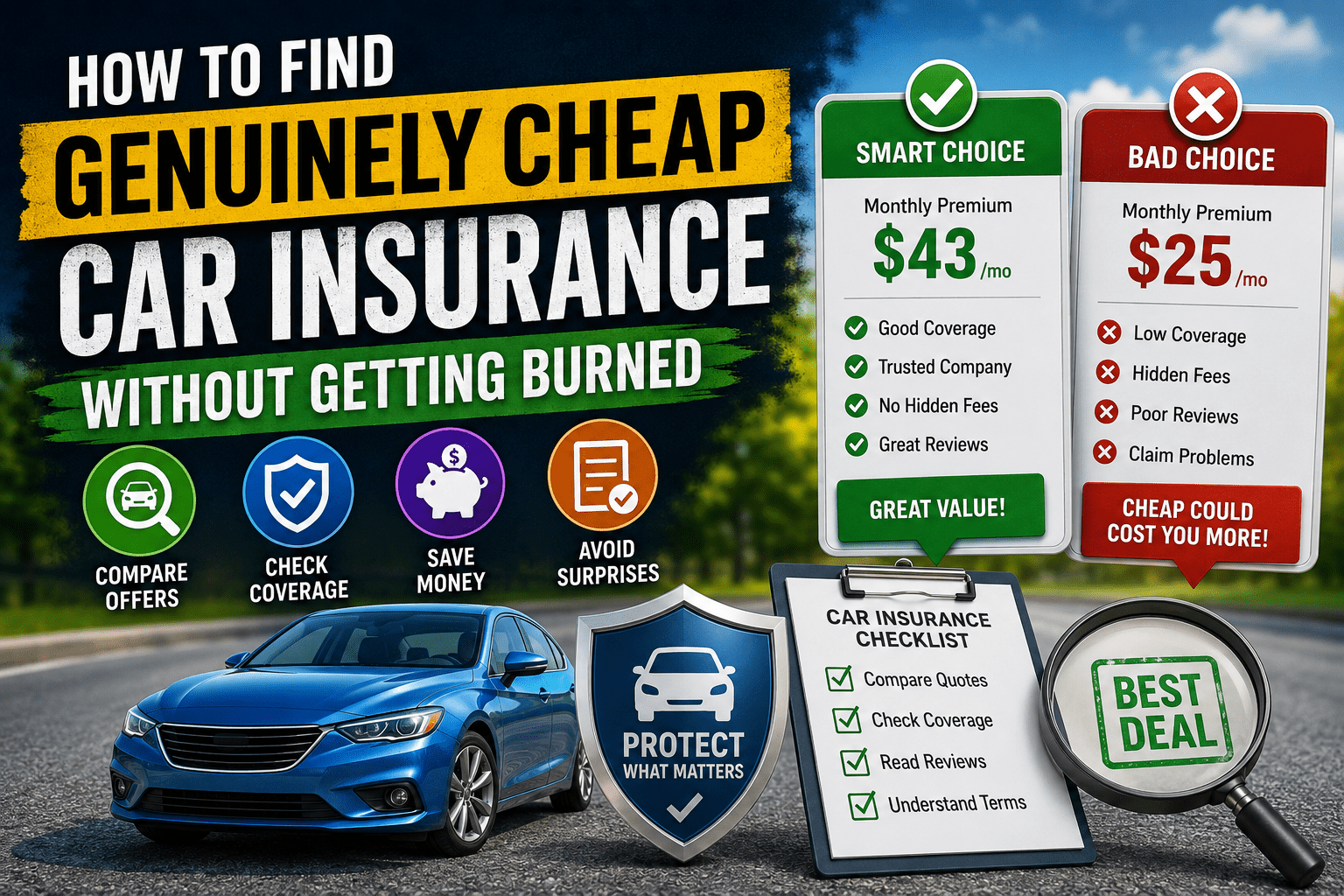
Finding cheap car insurance isn’t about picking the sketchiest carrier with the lowest number on a banner ad. It’s about systematically identifying every legitimate cost-reduction lever — deductibles, coverage adjustments, telematics programs, discount stacking, and smart comparison shopping — and applying them without exposing yourself to catastrophic financial risk. This guide walks through every real strategy I’ve personally tested, with a clear breakdown of what saves money safely versus what saves money dangerously. By the end, you’ll have a concrete action plan to reduce your premium this week.
⚡ TL;DR – Quick Summary
- Cheap car insurance is real — but only if you understand the difference between cutting cost and cutting coverage.
- Raising your deductible to $1,000–$1,500 is often the single fastest way to drop your monthly premium.
- Telematics programs (Snapshot, DriveEasy, etc.) can reduce your rate by up to 30% if you’re a safe driver.
- Dropping collision on an older car with low market value is often the right call — not a gamble.
- Annual payment, paperless billing, and good-student discounts are free money most people leave on the table.
The Day I Realized I Was Paying a “Loyalty Tax” on My Car Insurance
My cousin Marcus called me in October a couple of years back. He was 34, clean driving record, two-door Honda Civic, suburban Chicago zip code — almost identical profile to mine. He was paying $88 a month for full coverage. I was paying $154 for nearly the same thing. Same state. Same coverage tier. I sat in silence for a long second.
I’d been with my insurer for six years without ever questioning it. Six years of automatic renewals. Six years of never picking up the phone to say, “Hey, is this still a competitive rate?” That one conversation cost me roughly $3,984 in overpayments. And all it would have taken to avoid it was about an hour of shopping.
That’s the “loyalty tax” — the premium surcharge that long-term customers silently pay while new customers get acquisition discounts. Insurance companies bank on your inertia. The answer to cheap car insurance, more than anything else, is simply refusing to stay inert.
💡 My Recommendation: Never auto-renew without comparing. Even spending 20 minutes on an aggregator site each year can uncover $200–$600 in unnecessary spending. Treat your renewal notice as a starting gun, not a finish line.
What Does “Cheap Car Insurance” Actually Mean — and What Should It Never Mean?
The word “cheap” is doing two jobs at once in this conversation — and confusing them is what gets people hurt. There’s cheap as in efficiently priced and cheap as in inadequately covered. The first is your goal. The second is a trap.
Efficiently priced insurance means you’re getting the coverage you actually need — no more, no less — from a carrier that prices your specific risk profile fairly. Inadequately covered insurance means you’ve hollowed out your protection to hit a monthly number, and you’ll only discover the damage when you file a claim and find out you’re on the hook for $40,000 that your policy refuses to pay.
| Cost-Cutting Move | Type | Typical Monthly Savings | Risk Level |
|---|---|---|---|
| Raise deductible from $500 to $1,000 | Smart | $15–$35 | Low (if you have savings) |
| Drop collision on car worth under $4,000 | Smart | $30–$60 | Low (car isn’t worth insuring) |
| Enroll in telematics / usage-based program | Smart | $20–$60 | None (if you drive safely) |
| Pay annually instead of monthly | Smart | $8–$20 | None |
| Take state minimum liability only | Risky | $25–$50 | High — lawsuit exposure |
| Remove uninsured motorist coverage | Risky | $10–$25 | High — 1 in 8 drivers uninsured |
| Choose insurer with poor claims rating | Risky | $10–$40 | Very High — when you need it most |
Is Raising Your Deductible the Smartest Move for Cheap Car Insurance?
In most cases, yes — with one important condition. The deductible-raise strategy only makes financial sense if you have enough in an emergency fund to cover the higher out-of-pocket cost if you need to file a claim. If you’re going from $500 to $1,500, you need $1,500 accessible somewhere. If that’s a problem, start smaller.
Here’s the math I ran on my own policy last year: raising my comprehensive and collision deductible from $500 to $1,000 saved me $27/month — $324/year. If I never file a claim, I pocket $324 annually. If I do file a claim, I’m out an extra $500. My break-even point is about 18 months of clean driving — which, given my record, is basically certain.
🎯 If I Were You… I’d raise my deductible to $1,000 right now and open a dedicated savings account — I literally called mine “Car Emergency Fund.” Put $50/month in it automatically. Within 10 months you’ve self-funded the entire deductible, and from that point forward, the lower monthly premium is pure profit.
How Does Your Deductible Choice Affect Your Annual Net Cost?
| Deductible | Est. Monthly Premium | Annual Premium | Max Out-of-Pocket (claim) | Annual Savings vs. $500 |
|---|---|---|---|---|
| $250 | $168 | $2,016 | $250 | −$240 (costs more) |
| $500 | $148 | $1,776 | $500 | Baseline |
| $1,000 | $121 | $1,452 | $1,000 | +$324/yr |
| $1,500 | $109 | $1,308 | $1,500 | +$468/yr |
| $2,000 | $97 | $1,164 | $2,000 | +$612/yr |
*Figures are illustrative estimates based on typical market ranges. Your actual savings will vary by insurer, vehicle, and state.
Can Telematics Programs Really Deliver Cheap Car Insurance — or Is It Just a Monitoring Trap?
I’ll be honest: when telematics programs first became popular, I was skeptical. The idea of an insurance company tracking my driving felt invasive. Then I did the math — and tried it — and changed my mind completely.
I enrolled in Progressive’s Snapshot program for six months. I commute less than 20 miles a day, I don’t drive late at night, and I don’t brake hard. By the end of the period, my rate dropped 22%. That was $31/month — $372/year — saved for doing exactly what I was already doing.
The “monitoring trap” concern is legitimate for drivers who speed, brake hard, or drive frequently between midnight and 4am. The app penalizes those behaviors. But for the majority of everyday drivers, telematics is one of the most powerful paths to cheap car insurance that actually exists.
Progressive Snapshot
Tracks speed, braking, time of day. Savings up to 30%. Sign-up discount just for enrolling.
Best for: daily commuters
State Farm Drive Safe & Save
Tracks mileage and driving patterns. Up to 30% savings. Works via OnStar or mobile app.
Best for: low-mileage drivers
Allstate Drivewise
Rewards safe driving every 6 months. Cash back possible. Tracks speed, hard braking, night driving.
Best for: consistent safe drivers
GEICO DriveEasy
Mobile app-based. Tracks distracted driving (phone use), speeding, hard braking. Up to 25% off.
Best for: phone-free drivers
💡 My Experience: I tried Snapshot for one policy period. The only habit I had to break was checking my phone at red lights — which I should have broken anyway. The 22% discount more than paid for any minor inconvenience. If you’re a safe, low-mileage driver, this is arguably the single most underused cheap car insurance tool available.
Step-by-Step: How I Cut My Car Insurance Bill in One Afternoon
This is the exact process I followed the last time I re-shopped. Start to finish, it took about 3 hours. I saved $510 annually.
Pull Your Current Policy Declaration Page
Log in and download it. Know exactly what you’re paying and what coverage you currently have. This is your benchmark. Every new quote must be compared against it — same limits, same deductibles — or your comparison is meaningless.
Check Your Car’s Current Market Value
Use a tool like Kelley Blue Book or Edmunds. If your car is worth less than $5,000–$6,000, seriously consider whether collision coverage makes financial sense. Your insurer will only pay the car’s actual cash value at time of claim — minus your deductible. On a $4,000 car with a $1,000 deductible, you’d receive $3,000 max.
Get 5 Quotes with Identical Coverage
Don’t let any quote tool talk you into “recommended” levels — stick to the same coverage you benchmarked in Step 1. Use at least two direct insurer sites plus one independent agent. The agent quote is often the most revealing because they can shop 10+ carriers at once.
Ask Every Agent to Stack Every Applicable Discount
Read this list aloud: good driver, multi-car, bundle (home/renters), pay-in-full, paperless, anti-theft, telematics enrollment, low-mileage, defensive driving course, profession (teachers, nurses, military often get extra). I once unlocked four discounts in a single 10-minute phone call that weren’t on the initial quote.
Consider Raising Your Deductible on the Winning Quote
Once you’ve found the best base price, ask for a quote with a $1,000 and a $1,500 deductible. Often, this final tweak saves another $15–$30/month on an already-competitive quote. Only do this if you have or can build the corresponding emergency fund.
Negotiate Against Your Current Insurer
Call your existing insurer last. Tell them you have a competing quote at $X. Ask if they can match or beat it. About 40% of the time, they can — and they will, because losing a customer is worse than dropping your rate. If they can’t match it, switch without hesitation.
Enroll in Telematics on Your New Policy
Most insurers give you an enrollment discount just for signing up — before they even see how you drive. If you’re a safe driver, this becomes a permanent, compounding discount on an already-reduced premium. It’s the final layer of cheap car insurance optimization.
When Does Cheap Car Insurance End Up Costing You More?
A friend of mine — I’ll call her Deanna — saved $44/month by switching to a bare-bones policy with state minimum liability limits and no uninsured motorist coverage. She felt great about it. Then, eight months later, someone ran a red light and totaled her car. The at-fault driver had no insurance.
Without uninsured motorist coverage, Deanna had no recourse through her own insurer. She had to pursue the at-fault driver through small claims court — a process that took 14 months and recovered zero dollars because the driver had no assets. Her $44/month “savings” cost her a $12,000 car.
There are certain coverage lines you simply do not strip out, no matter how cheap you’re trying to go. Uninsured/underinsured motorist coverage is one. Adequate liability limits are another. The cost difference between minimum and reasonable liability limits is often less than $15/month — and the exposure difference is catastrophic.
🎯 If I Were You… I’d treat uninsured motorist and minimum $100K/$300K liability limits as non-negotiables. Everything else is adjustable. But those two items are the floor beneath which cheap car insurance stops being smart and starts being dangerous.
Real Questions About Cheap Car Insurance — Answered Honestly
My Final Recommendations on Cheap Car Insurance
01
Raise your deductible — but only with a funded emergency account to back it up. This is the easiest $300+ annual saving available to most drivers today.
02
Enroll in telematics if you’re a safe, low-mileage driver. The privacy trade-off is modest; the savings are substantial and real.
03
Never strip out uninsured motorist or drop below $100K/$300K liability. Cheap insurance that doesn’t cover real catastrophes isn’t insurance — it’s false confidence.
04
Treat every renewal as a fresh bidding event. Your loyalty is worth nothing to your insurer — and your awareness is worth hundreds to you.
Continue Reading in This Series
- ← Back to Pillar: Car Insurance Quotes — The Complete Guide
- Senior Car Insurance: The Complete Rate & Discount Guide for Drivers 55+
- Discount Car Insurance Quote: Every Savings Lever, Fully Explained
- Home and Auto Insurance Quote Comparison: Bundle Smarter, Save Bigger
- Car and Homeowners Insurance Quotes: Bundle vs. Separate
- Home and Auto Quotes: The 60-Minute Savings Process






1 Response
[…] For a deep dive into finding the lowest legitimate rates without sacrificing real protection, read my dedicated guide: How to Find Genuinely Cheap Car Insurance Without Getting Burned. […]