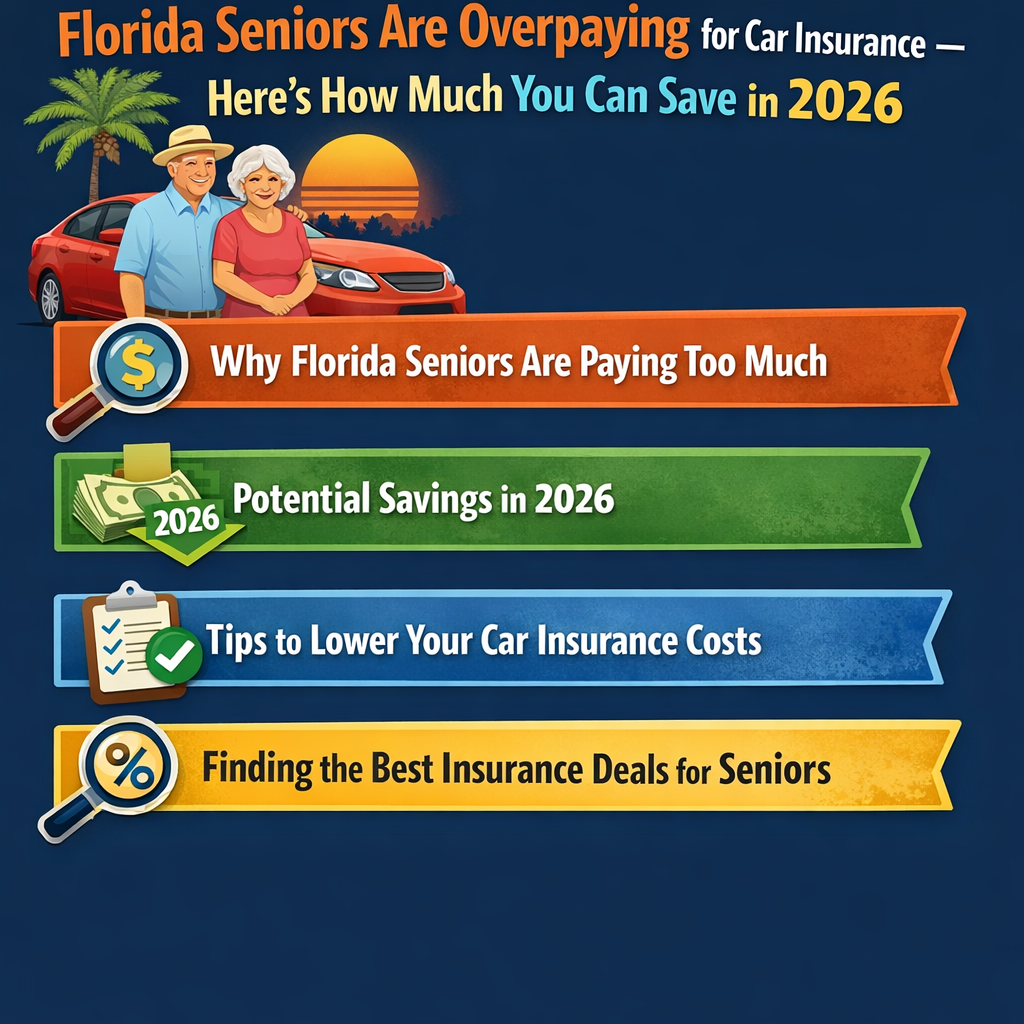
Florida Seniors Are Overpaying for Car Insurance – Here’s How Much You Can Save in 2026
I’ve spent the last decade watching my neighbors, family members, and friends in Florida get quietly drained by car insurance bills that nobody ever told them they could fight back against. This guide is everything I wish someone had handed me — and them — years earlier.
⏱ Short Summary
Florida seniors — especially drivers over 65 — are often paying hundreds of dollars more per year than they need to. Between loyalty penalties, missed discounts, and over-coverage on older vehicles, the average overpayment runs $400–$900 annually. The solution isn’t complicated: shop around, take a defensive driving course, bundle your policies, and stop letting your insurer auto-renew without a fight. This guide walks you through every step with real numbers, real stories, and a direct path to keeping more money in your pocket in 2026.
TL;DR – Quick Summary: Are You One of the Florida Seniors Losing Money Right Now?
- Florida seniors overpay an average of $400–$900/year compared to comparable drivers in other states.
- The #1 reason: auto-renewal without shopping around.
- Discounts you’re probably missing: defensive driving, telematics, multi-policy bundling, low-mileage, and senior-specific programs.
- Best companies for Florida seniors in 2026: GEICO, State Farm, Amica, USAA (veterans), and Progressive.
- A 45-minute effort — comparing quotes online — can save you $300–$700 this year alone.
Is Florida’s Car Insurance Market Really as Bad as They Say — Or Is It Even Worse?
Let me tell you about my neighbor, Don.
Don is 71. He drives a 2015 Toyota Camry. He’s had maybe two minor fender-benders in 40 years of driving — neither of which was his fault. He retired comfortably, lives on a fixed income in Sarasota, and pays $2,340 per year for car insurance with a company he’s been loyal to since 1998.
I sat with him last spring and pulled up three competing quotes online in about 40 minutes. The lowest came in at $1,570 — for the same coverage levels. That’s $770 per year sitting on the table. Multiplied over five years, Don had handed his insurer nearly $3,800 in “loyalty tax” without realizing it.
Don’s story isn’t rare. It’s the norm.
Florida is consistently ranked among the most expensive states for car insurance in the entire country — and has been for years. The combination of dense traffic, frequent hurricanes and flooding, a high rate of uninsured drivers, and rampant insurance fraud has created a market where premiums are structurally elevated. For seniors, the situation is compounded by age-based pricing models that many insurers quietly apply after age 65 or 70.
📍 My Experience
I started digging into this issue after watching three separate people in my circle overpay dramatically — a retired schoolteacher in Tampa, a veteran in Jacksonville, and Don in Sarasota. Each of them had excellent driving records. Each of them was paying rates that bore no rational relationship to their actual risk. That’s when I realized this wasn’t a one-off — it was a pattern baked into the system.
How Much Are Florida Seniors Actually Overpaying — Do the Numbers Hold Up?
Let’s get specific. Below is a comparison of average annual car insurance premiums for Florida seniors versus the national average for seniors and the Florida general average — across different age brackets and coverage levels.
| Age Group | FL Senior Avg. | National Senior Avg. | Overpayment Est. | Coverage Level |
|---|---|---|---|---|
| 65–69 | $2,080 | $1,560 | +$520 | Full Coverage |
| 70–74 | $2,310 | $1,680 | +$630 | Full Coverage |
| 75–79 | $2,690 | $1,890 | +$800 | Full Coverage |
| 80+ | $3,050 | $2,100 | +$950 | Full Coverage |
| 65–74 | $1,240 | $930 | +$310 | Minimum / Liability |
These numbers are eye-opening but they don’t tell the full story. What they don’t capture is the compounding overpayment from loyal, long-term customers. Insurers know — and studies confirm — that policyholders who stay with the same company for 5+ years rarely shop around. They charge more, incrementally, every renewal cycle. It’s not illegal. But it is, in my opinion, predatory.
The technical term is “price optimization” — and Florida has some guardrails against it, but enforcement is patchy at best.
Why Are Florida Seniors Charged So Much — What Are the 6 Biggest Reasons?
Understanding why you’re overpaying is the first step to stopping it. Here are the six most common culprits I’ve identified:
1. Does Auto-Renewal Work Against You?
Absolutely. Every time you let your policy auto-renew without comparing quotes, you’re essentially telling your insurer: “I trust you to keep my rate fair.” They have no financial incentive to do that. The average rate increase at renewal — even with a clean record — runs 3–8% per year in Florida. Over five years, that’s a 15–40% price creep with no corresponding increase in your driving risk.
2. Are You Paying Full Coverage on a Car Worth Less Than $6,000?
This is one of the most common and costly mistakes I see. If your car’s current market value is under $6,000–$7,000, comprehensive and collision coverage rarely makes financial sense — especially with a $500–$1,000 deductible. You could be paying $800–$1,200 per year for coverage that would only net you $4,000–$5,000 in the absolute worst case. Drop it. Carry liability and PIP, and put the savings in a separate account.
3. Are You Skipping Discounts You’ve Already Earned?
This one stings. Many insurers don’t automatically apply every discount you qualify for. You have to ask. Defensive driving course? Ask. Low annual mileage under 7,500 miles? Ask. AARP or AAA membership? Ask. A multi-policy bundle with your homeowner’s or renter’s insurance? You’d better believe you need to ask — because they won’t volunteer it.
4. Is Your Credit Score Hurting Your Premium?
Florida allows insurers to use credit-based insurance scores as a pricing factor. A drop from “good” to “fair” credit can add $200–$500 per year to your premium. If your score has slipped — perhaps from medical bills or a change in income after retirement — your premium has likely climbed quietly right alongside it.
5. Are Uninsured Drivers in Florida Making Everyone Pay More?
Florida consistently has one of the highest rates of uninsured drivers in the U.S. — estimated at 20–26% of all drivers. This forces every insured driver to effectively subsidize claims caused by uninsured motorists through higher UM/UIM coverage costs and broader risk pool pricing. You’re not the problem — but you’re paying for it.
6. Are You Being Penalized for Simply Being Older?
Yes — and this is the most uncomfortable truth. Actuarial data does show that drivers over 75 have statistically higher accident rates. But the increases applied by many insurers go well beyond what the data justifies, especially for drivers with clean records. The disparity between a 68-year-old with no claims and a 68-year-old with two at-fault accidents can be as little as $300/year at some insurers — while the age penalty alone can add $600+. That math doesn’t work for clean-record seniors.
What Are the Best Ways to Actually Save Money on Car Insurance in Florida in 2026?
Here are the tactics that have made the biggest real-world difference — ranked by impact in my experience.
💡 Tactic #1: Should You Shop Around Every 6–12 Months?
Yes — this is non-negotiable. Shopping around is consistently the single highest-return action you can take. Studies show that drivers who compare quotes at every renewal save an average of $400–$700 per year. You are not obligated to stay with your current insurer. Loyalty has a price — and you’re the one paying it.
🗣 If I were in your shoes… I’d block 45 minutes on my calendar right now, go to three comparison sites (The Zebra, NerdWallet, and one direct insurer site like GEICO), input the same coverage levels across all three, and see what comes back. Don’t cancel anything yet — just see the number. That number alone is often enough motivation to act.
💡 Tactic #2: Can a Multi-Policy Discount Really Make a Difference?
It absolutely can. Bundling your auto insurance with homeowner’s, condo, or renter’s insurance typically saves 10–25% on both policies. If your annual auto premium is $2,200 and your homeowner’s is $1,800, a 15% bundle discount saves you $600/year across the two. That’s real money — and many people simply haven’t asked their current insurer if bundling is an option.
💡 Tactic #3: Is a Defensive Driving Course Worth Your Time in 2026?
Under Florida law, completing an approved defensive driving course entitles drivers 55 and older to a minimum 10% discount on their premium for 3 years. The course typically runs $20–$35 and can now be completed entirely online. If your base premium is $2,000, that’s a $200 annual savings from a 4-hour online class. The return on time investment is extraordinary. My recommendation: do it this weekend. You can be done before Sunday dinner.
💡 Tactic #4: Should You Try Telematics or Usage-Based Insurance?
If you drive fewer than 8,000–10,000 miles per year and drive primarily during daylight hours — which describes most retired Florida seniors — telematics programs can be a goldmine. Programs like Progressive’s Snapshot, State Farm’s Drive Safe & Save, and GEICO’s DriveEasy monitor your actual driving behavior through an app or plug-in device. Safe, low-mileage drivers routinely save 15–30%.
⚠️ My Honest Caveat
Telematics isn’t for everyone. If you drive at night frequently, have a long commute, or tend to brake sharply, the program might not benefit you — or could even raise your rate. Start with a program that only has upside potential (like State Farm’s, which can only lower your rate, never raise it) until you understand your driving profile.
💡 Tactic #5: Are There Senior-Specific Discounts You Haven’t Asked About?
Membership in AARP, AAA, or certain professional associations can unlock 5–15% discounts at participating insurers. AARP has its own auto insurance program through The Hartford. If you’re a veteran, USAA consistently offers the lowest rates in Florida for eligible members — and many veterans simply don’t know they qualify. Always mention every organization you belong to when getting a quote.
| Strategy | Estimated Annual Savings | Effort Level | Time to Implement |
|---|---|---|---|
| Shop around / switch insurers | $300 – $700 | Medium | 45–90 min |
| Multi-policy bundle | $200 – $600 | Low | One phone call |
| Defensive driving course (55+) | $150 – $300/yr (3 yrs) | Low | 4 hrs online |
| Telematics / usage-based program | $200 – $500 | Low | App sign-up, 30 days data |
| Drop collision on low-value car | $400 – $900 | Low | 5 minutes |
| AARP / AAA / veteran discounts | $80 – $250 | Very Low | Mention at quote time |
| Raise deductible ($500 → $1,000) | $100 – $300 | Low | One policy change |
Which Car Insurance Companies Are Actually Best for Florida Seniors in 2026?
Not all insurers treat seniors the same way. Some are structurally better for older, low-mileage, safe drivers. Here’s the honest breakdown:
| Company | Avg. Annual Premium (FL Senior) | Senior Discounts | Claims Satisfaction | Best For |
|---|---|---|---|---|
| USAA | ~$1,420 | ✅ Excellent | ⭐⭐⭐⭐⭐ | Veterans & military families |
| GEICO | ~$1,580 | ✅ Strong | ⭐⭐⭐⭐ | Budget-conscious seniors |
| State Farm | ~$1,720 | ✅ Strong | ⭐⭐⭐⭐⭐ | Service & telematics users |
| Amica Mutual | ~$1,810 | ✅ Good | ⭐⭐⭐⭐⭐ | High service standards |
| The Hartford (AARP) | ~$1,870 | ✅ Senior-focused | ⭐⭐⭐⭐ | AARP members |
| Progressive | ~$1,940 | ✅ Moderate | ⭐⭐⭐⭐ | Safe drivers / Snapshot users |
| Allstate | ~$2,280 | ⚠️ Limited | ⭐⭐⭐ | Convenience-focused drivers |
What Do Florida Seniors Actually Think of These Companies — Detailed Reviews
USAA – Best in Class, But Not for Everyone
If you or your spouse served in the military, USAA should be your very first call — no exceptions. Their rates are consistently the lowest in Florida for eligible members, their claims service is legendary (routinely #1 in satisfaction surveys), and they offer a suite of senior-friendly features including accident forgiveness and a rental car discount program. The only catch: you must have a qualifying military connection. Many people don’t realize that children and grandchildren of USAA members can also qualify.
GEICO – The No-Frills Price Leader
GEICO’s rates in Florida are among the lowest for seniors who don’t qualify for USAA. Their online quote process is fast and transparent. Where they fall short is in personalized service — if you like having a dedicated agent who knows your name, GEICO’s call-center model can feel impersonal. But if price is the priority and your situation is straightforward, it’s hard to beat them. Their DriveEasy telematics program is also worth exploring for low-mileage seniors.
State Farm – Best Balance of Price and Service
State Farm is the company I most often recommend to seniors who want a combination of competitive rates, a local agent relationship, and strong telematics savings. Their Drive Safe & Save program has a unique advantage: it can only lower your rate — it cannot raise it. For a senior who drives primarily during the day and within a modest radius, this program routinely delivers 15–25% discounts after 6 months. Their bundling discounts are also among the strongest in the state.
The Hartford / AARP – Purpose-Built for Seniors
The Hartford’s AARP auto insurance program is specifically designed for drivers 50 and older. Standout features include lifetime car repair assurance (repairs guaranteed for as long as you own the car), 12-month rate locks, and a RecoverCare benefit that covers home services (housekeeping, grocery delivery) after an accident if you’re injured. Their rates aren’t the lowest, but for seniors who want genuine peace of mind and comprehensive coverage, the value proposition is compelling — particularly if you’re already an AARP member.
Amica Mutual – The Quiet Overachiever
Amica doesn’t advertise aggressively, but it has one of the highest customer satisfaction records in the industry. Their claims process is consistently praised as fast, fair, and hassle-free — which matters enormously when you actually need to use your insurance. Their rates are slightly higher than GEICO or USAA, but for seniors who prioritize a smooth claims experience over absolute lowest price, Amica is a serious contender.
Step-by-Step: How Do You Actually Lower Your Florida Car Insurance Bill in 2026?
Here’s the exact process I walk people through. Follow it in order — don’t skip steps.
Gather Your Current Policy Details
Pull out your declarations page. Note your current coverage limits, deductibles, annual premium, and any discounts already applied. You can’t compare intelligently without knowing what you currently have. Also note your car’s current market value — look it up on Kelley Blue Book or Edmunds.
Decide What Coverage You Actually Need
Apply this simple rule: if your car is worth less than 10x your annual comprehensive/collision premium, dropping those coverages makes financial sense. Florida requires minimum 10/20/10 liability plus PIP, but I recommend at least 100/300/100 bodily injury if you have significant assets. See the coverage section later in this article for a full breakdown.
Get at Least 4–5 Competing Quotes
Use comparison sites (The Zebra, NerdWallet Insurance, Insurify) to pull multiple quotes at once. Also go directly to GEICO.com, StateFarm.com, and — if you’re a veteran — USAA.com. Input the same coverage levels at every site for a valid apples-to-apples comparison. Note each annual premium, deductible, and any exclusions.
Call Your Current Insurer and Ask for Retention Pricing
Before switching, call your current insurer. Tell them you’ve received quotes 20–30% lower and you’re considering leaving. Ask what they can do to retain your business. Many companies have unpublished “loyalty match” programs. This call takes 10 minutes and sometimes saves $200–$400 without changing anything. I’ve seen it work more often than not.
Register for a Defensive Driving Course
Go to the Florida DHSMV website or search “Florida 55+ defensive driving course online.” Pick an approved provider (IDriveSafely, Safe2Drive, and the AARP Smart Driver course are all widely accepted). Complete the course, get your certificate, and submit it to your insurer. The 10% discount applies for 3 years from completion. Set a calendar reminder to retake it in 3 years.
Enroll in a Telematics Program
If you choose State Farm, enable Drive Safe & Save when you sign up. For Progressive, opt into Snapshot. For GEICO, enroll in DriveEasy. Give the program 30–60 days of normal driving. Most report back with a discount percentage after that period. If you don’t like it, you can usually opt out.
Bundle and Confirm All Discounts in Writing
When you finalize your policy, ask for a written breakdown of every discount applied. Compare it to the list in this article. If anything’s missing, ask why. Confirm that your defensive driving discount, multi-policy bundle, membership discount, and telematics enrollment are all reflected before you pay your first premium.
Set a Repeat Reminder Every 6–12 Months
This is the step most people skip — and why they find themselves overpaying again in 3 years. Set a recurring reminder in your phone or calendar: every 6–12 months, pull three new quotes. The market changes. New competitors enter. Your current insurer’s pricing evolves. Spending 30–45 minutes per year on this can save you thousands over a decade.
✅ My Personal Recommendation
If I were sitting across from you right now, here’s what I’d say: do steps 1–4 this weekend. Not next month. This weekend. The comparison sites are free, the quotes take 10 minutes each, and calling your current insurer takes another 10. In under two hours, you could know exactly how much you’re overpaying — and have a plan to stop. The defensive driving course and telematics enrollment can happen the following week. Everything else flows from there.
What Car Insurance Coverage Do Florida Seniors Actually Need — And What Are They Paying For That They Don’t?
Florida’s minimum requirements and what you actually need are two very different conversations. Here’s a practical breakdown:
| Coverage Type | FL Minimum Required | Recommended for Seniors | Consider Dropping If… |
|---|---|---|---|
| PIP (Personal Injury Protection) | $10,000 | $10,000 (keep) | Never – legally required |
| Bodily Injury Liability | Not required* | 100/300k minimum | Only reduce if assets are minimal |
| Property Damage Liability | $10,000 | $100,000 | Don’t drop – lawsuits are expensive |
| Uninsured Motorist (UM/UIM) | Optional | Strongly recommended | Only if very tight budget |
| Collision Coverage | Optional | Only if car value > $12,000 | Car worth < $6,000–$8,000 |
| Comprehensive Coverage | Optional | Yes, if car value > $8,000 | Car worth < $6,000 |
| Roadside Assistance | Optional | Consider AAA instead | If you already have AAA |
*Florida does not require bodily injury liability coverage for most drivers, but this is one of the most important gaps to fill — especially if you have significant retirement assets.
FAQ – The Questions Florida Seniors Are Actually Asking (And Honest Answers)
Final Takeaway: What Happens If You Keep Doing Nothing About This in 2026?
Let me be direct with you — because I think you deserve that.
If you’ve read this far and you do nothing, your insurer will raise your rate again at renewal. Not because you’re a riskier driver. Not because claims costs have skyrocketed. But because the system is designed to extract money from customers who don’t push back — and retirees on fixed incomes are quietly one of the most systematically overcharged groups in Florida.
Don — my neighbor from Sarasota — switched to State Farm in March. He enrolled in Drive Safe & Save. He took the online defensive driving course on a Saturday morning. His new annual premium: $1,480. His old premium: $2,340. That’s $860 per year back in his pocket. He spent maybe 3–4 hours total on the process.
Was it life-changing? Maybe not in isolation. But compounded over five years, that’s $4,300 — enough for a trip he’d been telling his wife about for years. More importantly, it was money he’d earned over a lifetime of careful, responsible driving. He just had to ask for it back.
You’ve read the guide. You have the framework. You know the companies, the strategies, the discounts, and the step-by-step process. The only thing standing between you and a lower premium is the decision to start.
If I were in your shoes right now…
I’d open a new browser tab, go to TheZebra.com, enter my current coverage details, and see what comes back. Five minutes. That’s all it takes to find out if you’re being overcharged. If you are — and the odds strongly suggest you are — you’ll have the information and the motivation to do something about it.
Don’t wait for your renewal notice. Don’t assume your current rate is fair because you’ve been a loyal customer. And don’t let another year pass without knowing whether the money sitting in your insurer’s pocket should be sitting in yours.
You’ve earned the right to a fair rate. Go get it.